Quick Summary
- Pain Rating: Most patients describe Sofwave as mild to moderately uncomfortable (typically rated 3 to 5 out of 10 with topical numbing), though it can spike higher over bony areas. It is rarely described as completely painless.
- The Sensation: Each pulse feels like a brief burst of intense internal heat, tingling, or a prickling sensation that vanishes the moment the pulse stops (about 3 to 5 seconds).
- Why It Hurts Less Than Older Ultrasound (Ultherapy): Sofwave targets a shallower depth (1.5 mm in the mid-dermis) and uses continuous contact cooling to protect the skin surface, avoiding the deep nerve pain and fat-layer ache associated with older technologies.
- Comfort Measures: Clinics routinely manage sensation with high-strength topical numbing cream.
- After the Session: Once the handpiece leaves your skin, acute pain ends immediately. You might feel a lingering mild sunburn-like warmth or slight tenderness for a few hours, but there is zero open-wound recovery.
If you are researching non-invasive skin tightening to lift the brow, jawline, or neck, you have likely run into two competing narratives about Sofwave: clinical brochures calling it “comfortable,” and real-world forum reviews calling it “spicy”.
So, what is the reality?
Sofwave isn’t a relaxing facial, but it isn’t an unmanageable ordeal either. When performed with standard comfort protocols, most patients find it completely tolerable. Understanding what causes the sensation, where it feels most intense, and how providers mitigate it will help you know exactly what to expect before you book your session.
What Does a Sofwave Pulse Feel Like?
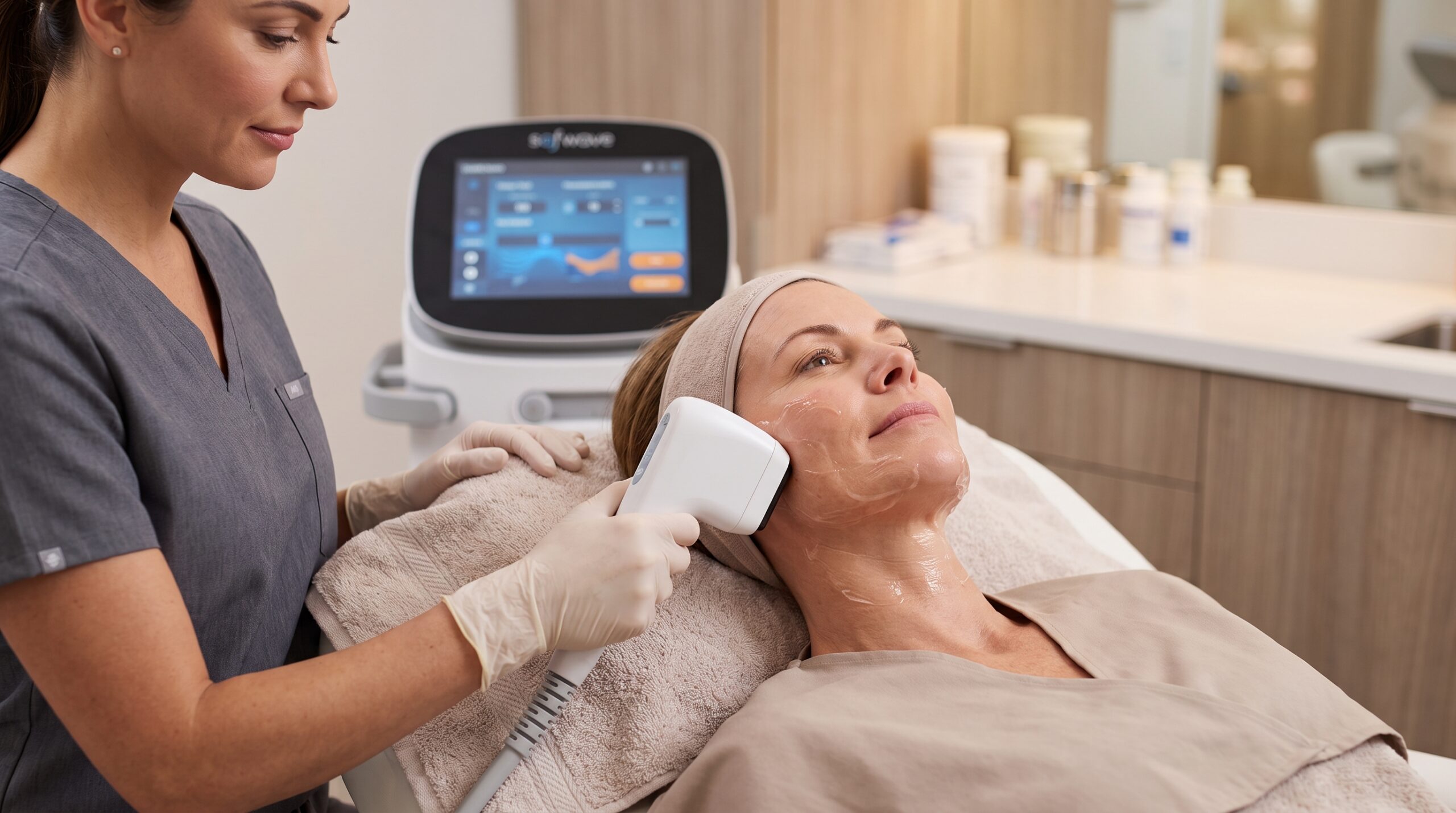
Sofwave uses Synchronous Ultrasound Parallel Beam (SUPERB™) technology. Rather than delivering a single point of energy, it projects seven parallel cylinders of ultrasound into the mid-dermis at an exact depth of 1.5 mm.
To remodel collagen and elastin, that tissue must reach a therapeutic temperature of roughly 60°C to 70°C. That localized heat is what you feel.
During each 3- to 5-second pulse, the sensation follows a very specific arc:
- The First Second: You feel the cool applicator tip resting against your skin.
- Seconds Two and Three: A sharp sensation of internal heat builds up under the surface, accompanied by a prickling or deep tingling vibration.
- The Cutoff: The moment the device beeps and finishes the pulse, the heat dissipates instantly. There is no lingering burn.
Where Does It Hurt Most?
Pain tolerance varies, but facial anatomy plays the biggest role in what you feel. Ultrasound energy reflects off bone, which can make certain passes feel significantly more intense than others.
Fleshy areas with more dermal cushion barely register discomfort, while thin skin directly over bone produces the sharpest pulses.
How Sofwave Compares to Ultherapy and RF Microneedling
One reason people worry about ultrasound tightening pain is the reputation of older technologies.
Sofwave vs. Ultherapy
Ultherapy delivers micro-focused ultrasound deep into the skin—down to 3.0 mm and 4.5 mm—targeting the SMAS layer (the same connective tissue tightened during a facelift). Because it fires energy near deep facial nerves and bone, patients frequently report intense, deep aching pain that sometimes requires oral sedatives or prescription analgesics.
Sofwave confines its energy strictly to the 1.5 mm mid-dermal band. It avoids deep nerve pathways and does not touch subcutaneous fat, eliminating the deep structural ache and the risk of accidental volume loss.
Sofwave vs. Radiofrequency (RF) Microneedling
Devices like Morpheus8 or Potenza combine physical needle punctures with radiofrequency heat. RF microneedling can feel like mechanical punching paired with heat, which often leads to several days of redness, swelling, and grid marks. Sofwave doesn’t break the skin barrier at all, eliminating mechanical puncturing and surface downtime.
How MedSpas Keep You Comfortable
No patient is expected to sit through Sofwave without comfort measures. Providers use a layered approach to keep sensation well within a tolerable range:
- Prescription Topical Numbing: High-strength compounded numbing cream (often a blend of lidocaine, tetracaine, and prilocaine) is applied for 45 to 60 minutes before treatment. This blunts the sharp, superficial sting.
- SofCool™ Integrated Cooling: The Sofwave handpiece features a built-in cooling plate that chilled-contacts the epidermis throughout every pulse, protecting your outer skin from thermal injury while distracting sensory nerve endings.
- Energy Adjustments: An experienced provider can calibrate energy output slightly lower over sensitive landmarks (like the forehead rim) to keep you comfortable without sacrificing the overall collagen response.
Frequently Asked Questions
Does Sofwave hurt after the appointment is over?
No. Once the treatment ends, the acute prickling stops immediately. Your skin may feel warm—similar to a mild sunburn—or slightly tender to the touch for 1 to 3 hours, but there is no throbbing or persistent post-procedure pain.
Do I need prescription painkillers for Sofwave?
Most patients do not need oral pain medication. Over-the-counter acetaminophen (Tylenol) taken 45 minutes beforehand, combined with clinical-grade topical numbing, is sufficient for the majority of people.
Why do some online reviews say Sofwave was agonizing?
Negative reviews regarding pain usually stem from one of three issues: inadequate numbing time (less than 30 minutes), a provider using older protocol techniques without integrated cooling pauses, or someone treating very thin bony zones at maximum energy without cooling air. Choosing an experienced provider who uses cold-air devices and tailors energy levels makes a substantial difference.
Can I go right back to work after Sofwave?
Yes. Sofwave is a true no-downtime procedure. You might have faint pinkness for an hour or two, but because the epidermis remains completely intact, you can wash your face, apply skincare or makeup, and return to normal daily activities immediately.